
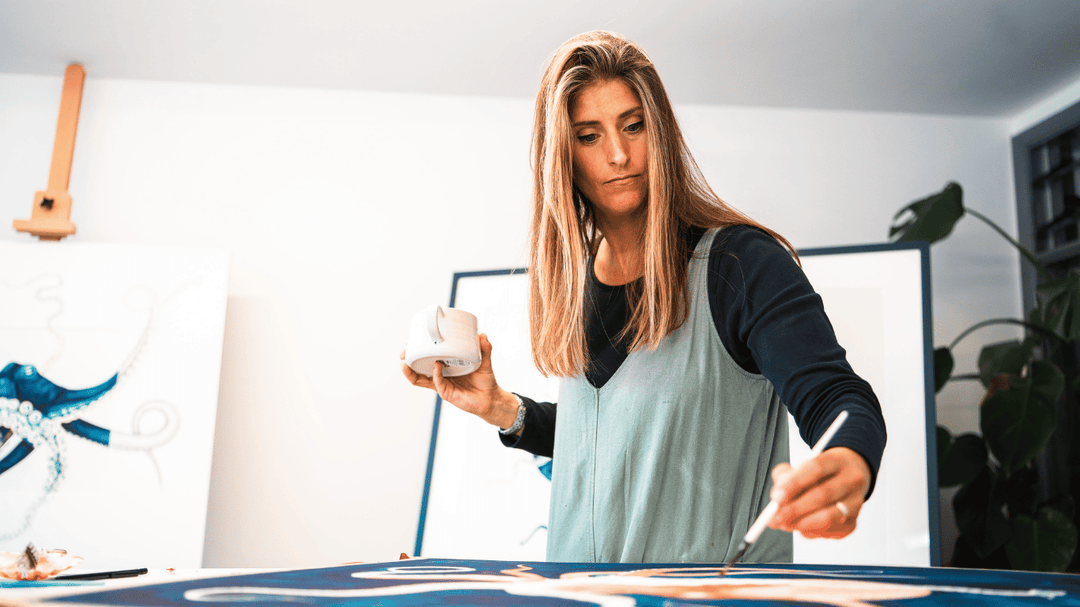
One thing to note about Samantha is that her style is constantly evolving. One reason for this is because of the inspiration she found in Paris; the city in which her studio is located. Paris draws artists in with its vibrant scene of people and culture. This was also true for artists in the late nineteenth and early twentieth century who gathered there and were essential to Modern art. The most notable art movements accredited to Paris in this time period are Fauvism, Cubism, Abstract art and Surrealism.
School of Paris
Numerous artists associated with the previously mentioned movements were also part of the School of Paris, a term first coined in 1925. Pablo Picasso is the most renowned artist from this group. He migrated to Paris from Spain in 1904 and worked with the French painter, Georges Braque, to create and develop Cubism. Picasso’s unofficial role as leader of the School was jointly held with another resident of Paris, Henri Matisse, who established Fauvism along with André Derain. Having these artists together in the same city led to them inspiring each other, a key example being Picasso’s response to Matisse’s Le Bonheur de Vivre (1905) with his painting Les Demoiselles d’Avignon (1907). They are both large scale paintings of nude figures. Picasso also saw Matisse’s work when it was displayed in the dining room of Gertrude and Leo Stein, a sibling duo who were patrons to numerous Modern artists, such as Matisse and Picasso. These artists collectively created an environment where they pushed each other to evolve, create and innovate.
 Atlantic Lobster Fine Art Print


Samantha and Paris
While Samantha’s heart belongs to the southwest coast of the UK, she is currently based in Paris. Her art is evolving and like the other artists mentioned earlier, she is creating what is right for her. This is illustrated with her Atlantic Lobster Fine Art Print and Blush Hour. Both works depict lobsters but in very different ways. The former focuses more on the anatomy of the creature while the latter appeals to the viewer with its vibrancy. Another thing to note is that Samantha has found inspiration for subject matter while in Paris in the form of a heart-shaped shrimp sculpture.


While she was motivated by an object in Paris, she still depicted marine life, which she is passionate about due to her love of nature and wildlife.
Written by Talia Adler on behalf of Samantha Frances Art
Sources:
Art Institute of Chicago, “Champs de Mars: The Red Tower,” https://www.artic.edu/artworks/9503/champs-de-mars-the-red-tower
Henrimatisse.org, “Joy of Life (Bonheur de Vivre), 1905 by Henri Matisse,” https://www.henrimatisse.org/joy-of-life.jsp#google_vignette
Kemp, Martin. “Picasso: Les Desmoiselles d’Avignon.” In Art LoVers: Celebrating Elisabeth de Bièvre and John Onians in Words and Pictures, edited by Gyöngyvér Horváth and Isabelle Onians. Archaeopress, 2025. https://doi.org/10.2307/jj.40302985.50.
The MET, “School of Paris,” https://www.metmuseum.org/essays/school-of-paris
Smarthistory, Dr. Beth Harris and Dr. Steven Zucker, "Pablo Picasso, Still Life with Chair Caning," https://smarthistory.org/picasso-still-life-with-chair-caning/.
Sotheby’s, “The Evolution of the School of Paris,” https://www.sothebys.com/en/articles/the-evolution-of-the-school-of-paris
TATE, “School of Paris,” https://www.tate.org.uk/art/art-terms/s/school-paris
TATE, “Fauvism,” https://www.tate.org.uk/art/art-terms/fauvism

Leave a comment